

Sunday Funnies: Censored Eleven
21 repliesThe Censored Eleven is a group of Looney Tunes and Merrie Melodies cartoons originally produced and released by Warner Bros. that were withheld from syndication in the United States by United Artists (UA) since 1968.
The cartoon output of Warner Bros. during its most active period even sometimes had censorship problems more complex in some respects than those of features. Unlike feature films, which were routinely censored in the script, the animated shorts were passed upon only when completed, which made the producers exceptionally cautious as to restrictions. In 1983, director Chuck Jones commented on the television censorship of the Warner Bros. cartoons: “I don’t like to see the films cut at all. […] They make some cuts that are so arbitrary and stupid, you can’t believe it.”
Hittin’ the Trail to Hallelujah Land is the only black-and-white short on the list, and the only cartoon to star Piggy. The short’s use of the racial epithet “Uncle Tom” prompted United Artists to withhold it from syndication in 1968, making it one of the Censored Eleven.
Comparison of steamboat piloting scenes in Steamboat Willie (top) and Hittin’ the Trail for Hallelujah Land.

Friz Freleng directed the largest number of cartoons on the list with four. Because of the racial stereotypes of black people throughout this short, it is withheld from circulation, one of the “Censored Eleven” shorts.
Boxoffice (Aug 22, 1936): “When a cartoon arouses enthusiasm in a projection room of hard-boiled critics, it denotes a hit. In Technicolor, this subject tells the story mostly in Negro rhythm and tuneful jazz.”
National Exhibitor (Sept 5, 1936): “One of the best in the series this, however, should not be played on the same bill with Green Pastures. The shiftless darky doesn’t want to go to church on Sunday, escapes from his wife, runs away, is knocked out chasing a chicken, dreams he is in Hell where he is made the ball in a bagatelle (pinball) game with other things happening to him. Finally he wakes up, heads for church. Color, animation, gags are above average with the whole thing a stand out. Very Good.”
Schlesinger and Warner Bros. had problems with Clean Pastures from the start. Hollywood censors alleged that the film ran afoul of the Hays Production Code because it burlesqued religion. Later commentators surmise that the censors also objected to the portrayal of a Heaven run by African Americans.
Probably the most controversial short on the list, the wiki article on it https://en.wikipedia.org/wiki/Clean_Pastures is pretty interesting.
The cartoon plays off Harriet Beecher Stowe’s novel in that it portrays Uncle Tom as an old man, and wooden shacks and cotton fields pervade the scenery. Director Tex Avery adds his own sense of humor and “trickster” animation, giving the classic theme a modern, humorous twist.
On June 1, 1937, Selected Motion Pictures called the film “an interesting travesty in Technicolor of the well-known story.” The National Board of Review of Motion Pictures called it “highly amusing.”
The Film Daily said on January 31, 1938, “Producer Leon Schlesinger goes to darkest Africa in this one with a highly amusing set of characters… There are some very funny sequences and gags, with the characterizations very amusing.”
National Exhibitor agreed on February 1: “It sounds forced to say that this is better than the best so far, but that is what one must say about a series that improves continually. This is full of cute little touches that will be best appreciated by a class audience, but will still have the masses chuckling.”
The Isle of Pingo Pongo is also the only Elmer Fudd cartoon on the list.
Motion Picture Herald printed a letter from an exhibitor in their “What the Picture Did For Me” section: “These Merrie Melodies are as good as the Walt Disney stuff.”
All This and Rabbit Stew is the only Bugs Bunny cartoon on the list and is the final Avery-directed Bugs Bunny short to be released. Although it was produced before The Heckling Hare (after the production of which Avery was suspended from the Schlesinger studio and defected to Metro-Goldwyn-Mayer)
In January 1943, the film press greeted the cartoon with glowing reviews, and no mention of stereotype or offense. Motion Picture Exhibitor said, “A satire on Snow White done in blackface, set in modern swing, this is the best in a long time. It’s very funny.” The Film Daily agreed, saying, “Set this one down as a rather amusing satire on Snow White and the Seven Dwarfs. All the characters in the latter are replaced by darkies… The dwarfs come to the rescue in a way that makes for numerous laughs.”
In April 1943, the NAACP protested the caricatures which appeared in Coal Black and de Sebben Dwarfs, and called on Warner to withdraw it.
Author and music critic Will Friedwald writes, “Tin Pan Alley Cats is an animated equivalent to the live-action features Stormy Weather (1943) and Cabin in the Sky (1943), which represented both the climax and the conclusion of the all-black Hollywood musical spectacular… The only thing that’s the matter is that Tin Pan Alley Cats represents a near last stand for both black characters and extended musical numbers in the Hollywood cartoon.”
Angel Puss is the only cartoon directed by Jones on the list, as well as the only Looney Tunes cartoon on the list.
On October 7, 1944, Herman Hill wrote an editorial for the African-American weekly The Pittsburgh Courier titled Angel Puss vs. Americans for All. Hill wrote, “Basis for the spontaneous protest by the long and patient suffering Negro theater-going public were the many forth-right expressions of condemnation regarding Warner Brothers’ animated cartoon Angel Puss. Almost in direct irony was the picture’s showing in Los Angeles, in that it was sandwiched between the main feature and March of Time’s Americans for All, which theme is directly aimed at the lessening of racisms.
Goldilocks and the Jivin’ Bears is the only cartoon on this list not to be produced by Leon Schlesinger.
Motion Picture Exhibitor (Sept 6, 1944): “This hilarious burlesque on fairy tales has the three Jivin’ Black Bears going to town with some red hot music… With rhyme, colored dialect, swell music accompaniment, this is tops. Excellent.”
That’s all folks!
About Author

Addendum from wiki:
Several more cartoons have been removed from circulation since the list was created, but have not been added to the Censored Eleven list. These include numerous World War II-era cartoons involving the Japanese, such as Bugs Bunny Nips the Nips and Tokio Jokio.
Some cartoons that remain in the release have been heavily edited to remove stereotypical depictions of African Americans, including the Gone With the Wind satire Confederate Honey. Fresh Hare is often shorn of a scene in which a blackface Bugs and Elmer sing Camptown Races. Friz Freleng’s cartoon September in the Rain features some stereotyped black characters but is not entirely focused on them, so has occasionally reappeared without them. An early Porky Pig cartoon with stereotypical depictions of black people is Porky’s Railroad (also 1937).
A number of shorts are rarely shown owing to stereotyping and potentially offensive characterizations of Native Americans. They include The Hardship of Miles Standish (1940), Slightly Daffy (1944), A Feather in His Hare (1948), Nothing But the Tooth (1948), Tom Tom Tomcat (1953), Horse Hare (1960), Hocus Pocus Powwow (1968), and Injun Trouble (1969).[5] The 1946 short Book Revue is withdrawn from Cartoon Network and Boomerang and is omitted from its app due to the brief sequence showing various male characters suggestively reacting towards a sultry Native stripper.
fascinating stuff, pomp … especially the Clean Pastures (all of them, really) … sometimes I’m torn between “wow, could it possibly be any more racist?” and “these need to be seen as a reminder of just how racist we’ve been!” and “come on, this is ART, and more than that it’s PARODY a la SNL among others”
yeah, why I presented w/o comment.
I don’t believe it was done with malicious intent,..unintended or parody
parody (my best guess)
1. Andy Reid (Chiefs)Season: 11th with KC, 24th as HC
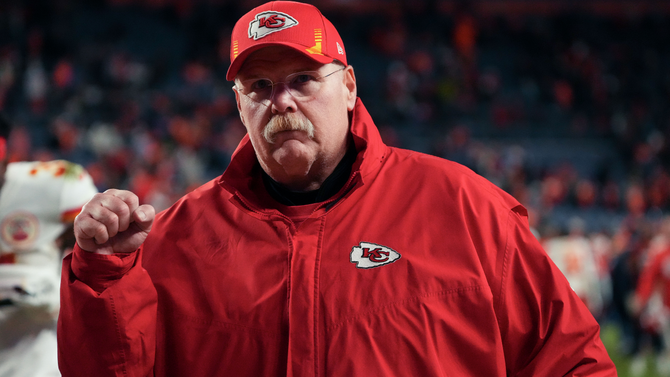
Career record: 247-138-1 | Playoffs: 22-16 (2-2 in Super Bowls)
Andy Reid USATSI
The gold standard. Whereas Belichick may own this spot on the all-time leaderboard, Reid is far and away the best at what he does in 2023. He’s not perfect (insert tired joke about clock management). But he and Patrick Mahomes are the modern-day equivalent of what Belichick and Brady were for the Patriots, except with much more explosive creativity. Like his naturally gifted QB, his biggest threat these days is probably boredom. His Chiefs have won at least 11 games in eight of his 10 seasons since he left the Eagles, and somehow the playoff record is even better: five straight AFC title-game appearances, with two Super Bowl trophies in the last four years. Anyone taking Reid or his guys lightly at any point in the season is doomed to suffer the consequences.
https://www.cbssports.com/nfl/news/2023-nfl-head-coach-rankings-andy-reid-remains-no-1-as-disciples-doug-pederson-john-harbaugh-crack-top-10/
OT is up
did we win?
probably
did you know that I am a year younger than Melissa Etheridge
did I care :)
fire this up
Kansas City Chiefs quarterback Patrick Mahomes is back as the best player in my ranking of the NFL’s top 100, and if he keeps up at his current pace he will be in the conversation for No. 1 all time.
Mahomes led his Chiefs to his second Super Bowl title last February, beating the Philadelphia Eagles and winning both the regular-season and Super Bowl MVPs in the process. The man is on a roll. In the past four seasons, he has two Super Bowl victories and one loss in the Super Bowl. He also has two regular-season MVPs in the past five seasons.
Oh, and he’s only 27. That should scare the heck out of the rest of the NFL. He isn’t even in his prime yet. Tom Brady, he’s coming for you.
https://www.cbssports.com/nfl/news/top-100-nfl-players-of-2023-patrick-mahomes-no-1-as-qbs-go-1-2-3-nick-bosa-top-defensive-player/
6
Travis Kelce
KANSAS CITY CHIEFS TE
He caught 110 passes with 12 touchdown catches to solidify his position as the top tight end and one of the best weapons in the league. Can he be covered with one man? No way.
13
Chris Jones
KANSAS CITY CHIEFS DE
He led all interior linemen in sacks with 15.5, with his dominant play keying the Chiefs’ Super Bowl-winning defense. He is a true game-wrecker.
40
Creed Humphrey
KANSAS CITY CHIEFS C
He is among the best centers in the game, a key part of the Chiefs offense. Entering his third season, he has been a starter every year since coming into the league in 2021 and is equally good in the run game and pass protection.
Wide receiver Keenan Allen is listed at 6-foot-2, 211 pounds. Mike Williams is even bigger at 6-4, 218. Rookie first-rounder Quentin Johnston is 6-4, 215. Tight end Gerald Everett is 6-3, 240. Further down the depth chart, Josh Palmer is 6-1, 210; Jalen Guyton is 6-1, 212; Donald Parham is 6-8, 237; and Tre McKitty is 6-4, 246.
One person who seems fairly excited about this is new offensive coordinator Kellen More. “Having versatility on the offense, which I think we’re really, really excited about being able to use guys in different positions,” Moore said on The Season with Peter Schrager podcast. “Align them in different ways and utilize all that. We like to say we’ve got so much height on this team, we’re going to be throwing in a different jet stream. These guys … it’s gonna be a lot of fun.”
https://www.cbssports.com/nfl/news/kellen-moore-says-chargers-will-be-throwing-in-a-different-jet-stream-due-to-size-of-wide-receiver-corps/
Happy Fourth Dudes!
Good stuff Pomp, love the historical context. Thanks!